Understanding how to read sheet music is essential. You read sheet music by learning three things together: the staff and clef (which tell you pitch), the note and rest shapes (which tell you rhythm), and the key/time signature (which set the rules for the whole piece). Start by naming notes on the staff for your instrument's clef, then clap or count rhythms separately before combining pitch and rhythm. Most beginners build basic fluency within a few weeks of short, daily practice, reading a few lines a day matters more than one long session.
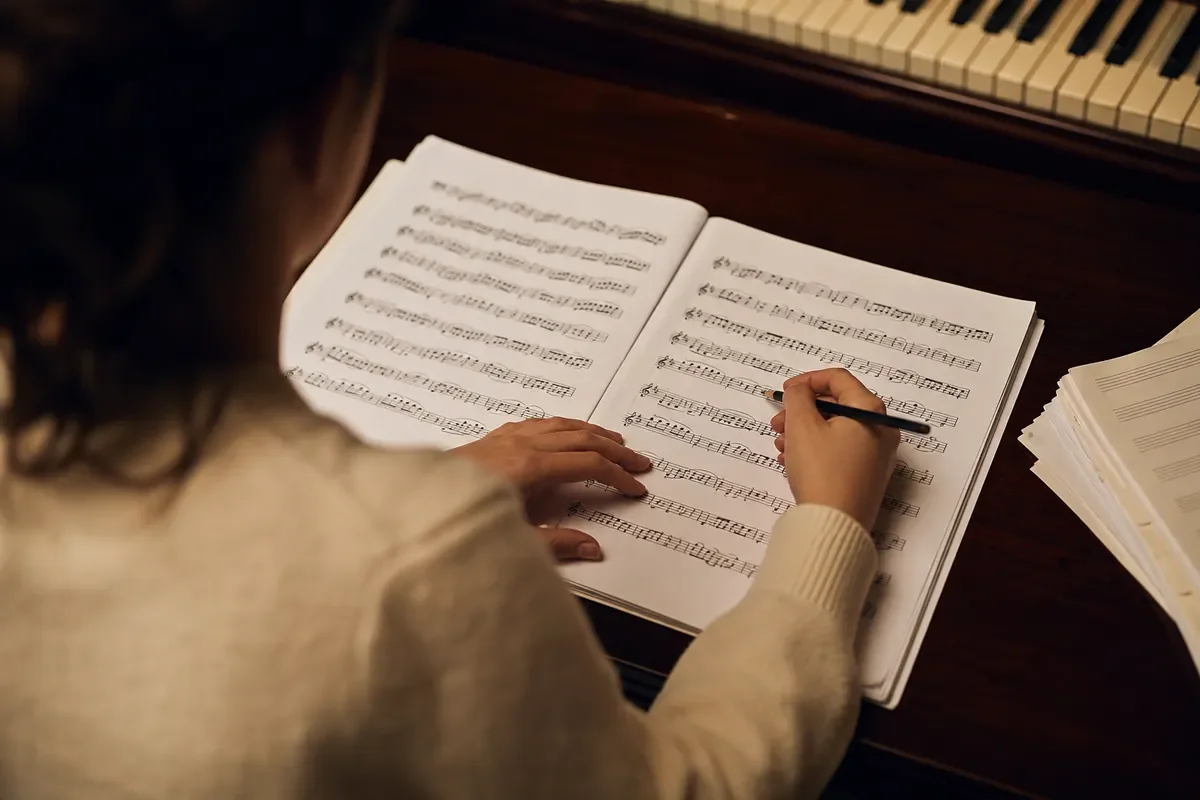
Learn the Building Blocks Before You Try to Read Sheet Music
Before reading a single note, get familiar with the staff, the five horizontal lines and four spaces that map out pitch, higher on the staff means higher pitch, lower means lower.
Each line and space represents a specific letter name (A through G, repeating), and where a note sits tells you exactly which pitch to play or sing. The clef symbol at the start of the staff anchors that whole system, telling you which lines and spaces correspond to which notes. Without a clef, the staff is just five lines with no meaning.
Which Clef Should You Learn First?
Pick the clef that matches your instrument or voice range, since that's the only one you need to start.
Treble clef (the curled symbol) covers higher-pitched instruments and voices, guitar, ukulele, violin, flute, and most vocal parts. If you're learning guitar or ukulele with Jessica Benini, this is the clef you'll use almost exclusively.
Bass clef handles lower-range instruments like bass guitar, cello, trombone, and the left hand on piano.
Alto clef is used mainly by viola players and is less common for beginners outside orchestral instruments.
Learn one clef well before touching the others. Trying to memorize all three at once slows everyone down.
Once you know your clef, the key signature and time signature act as the rules for the piece. The key signature (sharps or flats at the start) tells you which notes to alter throughout, and the time signature tells you how many beats fill each measure and what note value counts as one beat. Both are set once, at the top of the piece, and apply until the music says otherwise.
Can You Teach Yourself to Read Sheet Music?
Yes, self-teaching works for the basics, but a teacher speeds up the process by catching habits and gaps you wouldn't notice alone.
Plenty of musicians learn to read music independently using a method book or free sheet music found online. What a teacher adds is faster feedback, correcting finger placement, rhythm counting, or reading habits in real time rather than weeks later. Jessica Benini's private lessons pair reading skills with guitar, ukulele, harmonica, or vocal technique, so students apply notation to the instrument they actually want to play, not generic exercises.
To start, you need three things: a method book or free sheet music, a pencil for marking counts and fingerings, and the instrument itself.
Read Notes, Rhythms, and Timing on the Staff
Learning how to read sheet music comes down to two skills done at once: naming the pitch on the staff and counting how long it lasts. Master those separately first, then combine them.
On the treble clef, the lines from bottom to top spell E-G-B-D-F, remembered with "Every Good Boy Does Fine," while the spaces spell F-A-C-E. Bass clef lines read G-B-D-F-A ("Good Boys Do Fine Always") and spaces read A-C-E-G. These mnemonics give you a fast way to name any note without counting up from middle C every time.
Rhythm works on a similar shorthand, but with shapes instead of letters. A whole note (open oval, no stem) holds four beats, a half note (open oval with a stem) holds two, a quarter note (filled oval with a stem) holds one, and an eighth note (filled oval with a flag or beam) holds a half beat. The time signature at the start of a piece tells you how these durations fit into each measure: the top number sets how many beats per measure, and the bottom number sets which note value counts as one beat. In 4/4 time, you get four quarter-note beats per measure; in 3/4, three.
How Do Singers Read Music Differently Than Instrumentalists?
Singers track pitch by ear and interval relationship, how far the next note jumps from the last one, while managing breath marks and phrasing across a line of lyrics. Instrumentalists translate the same note into a finger position, fret, or valve combination, which adds a physical mapping step singers skip. A guitarist reading a chord chart, for example, thinks in shapes on the fretboard, while a vocalist thinks in melodic distance and where to breathe.
Practice Exercises to Move From Beginner to Intermediate
Clap or tap the rhythm of a simple melody line while counting beats aloud, ignoring pitch entirely.
Say the note names aloud in rhythm-free, even pacing, using the line and space mnemonics.
Combine both slowly: clap the rhythm while speaking note names, then move to your instrument or voice at a reduced tempo.
This sequencing mirrors how Jessica Benini works through new material with students in private lessons, isolating rhythm and pitch before asking a beginner to sing or play a phrase at full speed.
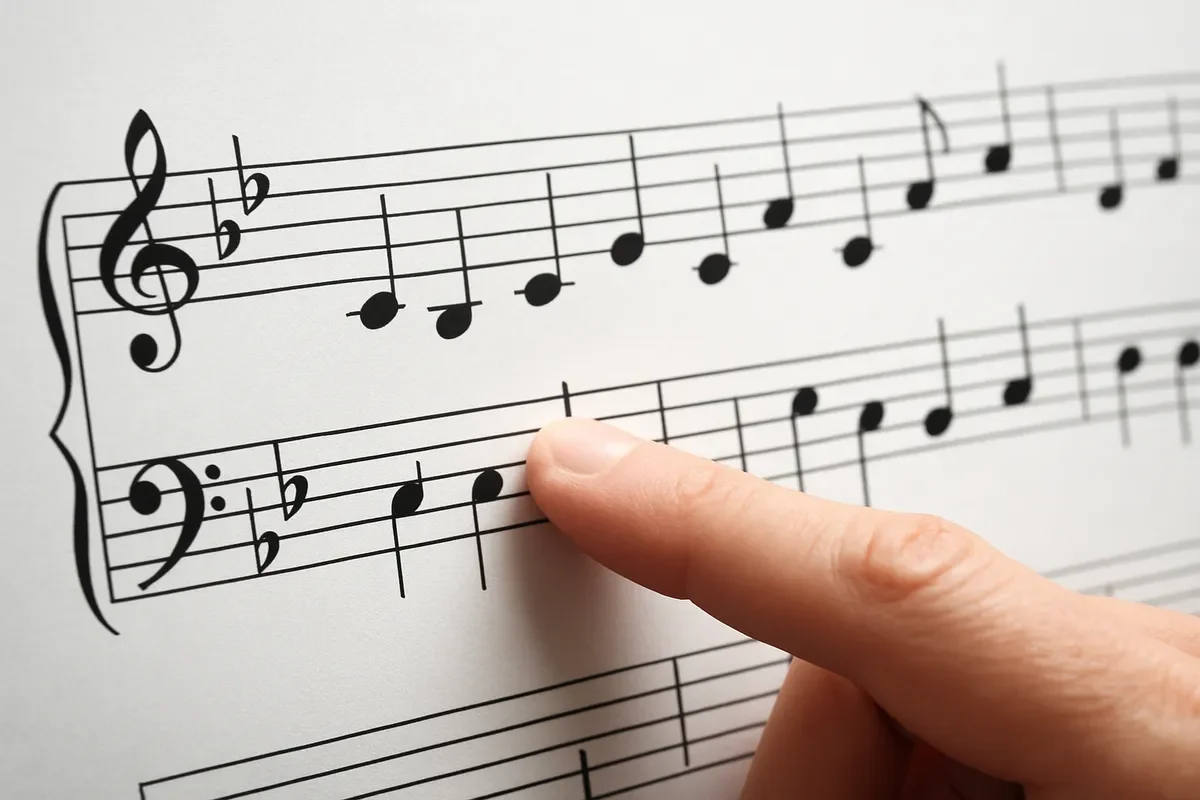
Interpret Symbols, Dynamics, and Markings on the Page
Notes and rhythm tell you what to play; symbols, dynamics, and markings tell you how to play it, and skipping them is the fastest way to sound stiff. Learning how to read sheet music well means training your eye to catch both layers at once.
Common Notation Symbols Beginners Encounter First
A handful of symbols show up in almost every beginner piece. Repeat signs (two dots before a double bar line) tell you to loop back and play a section again. Ties curve between two notes of the same pitch and mean you hold that pitch for the combined duration rather than replaying it. Slurs look similar but connect notes of different pitches, signaling a smooth, connected phrase rather than a rhythmic instruction.
Sharps (♯): raise a note a half step
Flats (♭): lower a note a half step
Naturals (♮): cancel a sharp or flat, returning the note to its plain pitch
These accidentals matter because they change the actual pitch you sing or finger, not just the feel of the passage.
How Tempo, Dynamics, and Articulation Change a Performance
Tempo markings sit at the top of a piece, often in Italian (Allegro, Andante, Moderato), and set the overall speed and mood before you play a single note. Dynamics markings, ranging from pianissimo (very soft) to fortissimo (very loud), tell you how much physical force or breath to use, whether that's a lighter pick stroke on guitar or a gentler push of air when singing.
Articulation marks shape technique note by note. A staccato dot means short and detached; a legato marking calls for smooth, connected motion; an accent mark (>) tells you to hit that note harder than the ones around it. On harmonica or guitar, these translate directly into how sharply you strike a string or push a breath.
Notes and rhythm determine what you play. Dynamics, tempo, and articulation determine how you play it, and that combination is what separates a technically correct performance from a musical one. In private lessons, Jessica Benini walks students through marked-up pieces on guitar, ukulele, and voice so these markings become instinct rather than an afterthought.
Apply How to Read Sheet Music on Your Specific Instrument
The staff, notes, and rhythms stay the same across instruments, but how to read sheet music in practice depends on the physical layout of what you're playing.
What's Different About Reading Music for Guitar, Ukulele, or Harmonica?
Guitar and ukulele rarely rely on standard notation alone. Most guitar and ukulele parts pair the staff with tablature (a six- or four-line grid showing which string and fret to play) or with chord charts showing finger placement on a diagram. Piano notation works differently: a note on the staff maps directly to one key, with no ambiguity about where to place your hands. On guitar or ukulele, the same pitch can often be played in several spots on the neck, so tab and chord charts exist to remove that guesswork.
Harmonica adds another layer. Many players learn from tab notation using numbers and arrows (1↑, 4↓, and so on) that show which hole to play and whether to blow or draw, rather than reading traditional notes on a staff. That number system is faster to pick up for beginners, but it limits you if you ever want to read a written melody line directly. Knowing standard notation first means the harmonica-specific tab becomes an added skill, not a replacement one.
Reading Sheet Music Beyond What Piano Players Learn
Vocalists use sheet music differently than instrumentalists do. Singers read the staff mainly for pitch contour and rhythm, paired with lyrics printed under the notes, to guide phrasing and breath placement rather than finger position. There's no fingering to decode, so the same page tells a completely different story depending on whether a guitarist or a singer is looking at it.
Switching instruments doesn't mean relearning notation from zero. It means re-mapping knowledge you already have onto new physical technique. A guitarist who picks up ukulele already reads rhythm and pitch; they're just adjusting to four strings instead of six. This is where private lessons matter. Jessica Benini teaches guitar, ukulele, harmonica, and vocal technique, and structures lessons around that translation step so students move between instruments without starting over each time.
What Are Music Notes?
Music notes are the symbols on the staff that tell you two things at once: which pitch to play and how long to hold it. Where the note sits on the five lines tells you the pitch. The shape of the note tells you the length. There are only seven letter names, A to G, and they repeat as you go higher, so every note you will ever read is one of those seven, higher or lower.
The shapes you meet first are the whole note (an open oval, four beats in 4/4 time), the half note (an open oval with a stem, two beats), the quarter note (a filled oval with a stem, one beat) and the eighth note (a filled oval with a flag, half a beat). A dot after any note adds half its length again. A rest is the silent version of each of those shapes and counts the same way. Once you can name the seven letters and the four basic shapes, you can read most beginner songs on ukulele, guitar or voice
Treble Clef Note
The treble clef is the one most of my students use, because guitar, ukulele and nearly all vocal parts are written in it. The five lines, from the bottom up, are E, G, B, D and F. The four spaces between them, from the bottom up, spell F, A, C, E. Notes that go higher or lower than the staff sit on short extra lines called ledger lines; middle C is the first ledger line below the treble staff.
The quickest way to learn treble clef notes is not a mnemonic but repetition on your own instrument. Take one line at a time. Find every E on your ukulele or guitar, play it while saying "E" out loud, then do the same for G. Add one letter a day. Within a week or two the note names stop being something you work out and become something you simply see, which is the whole point of reading music.
Common Mistakes to Avoid When Learning to Read Sheet Music
Most beginners slow their own progress with four habits: memorizing finger patterns instead of reading notes, ignoring rhythm, practicing without a steady tempo, and skipping the key or time signature.
The first mistake is treating sheet music as a map of finger positions rather than a set of pitches to identify. A student who memorizes "line, space, line" instead of naming the actual note (E, G, B) hits a wall the moment the piece changes key or introduces an unfamiliar interval. Naming every note out loud during practice, even slowly, builds the recognition skill that finger memory can't replace.
The second mistake is fixating on pitch while ignoring rhythm. A note played at the right pitch but wrong duration still sounds wrong, and rhythm is often the harder skill to internalize. Counting out loud ("1-and-2-and") while playing forces the brain to track time and pitch simultaneously, which is closer to how reading sheet music actually works in performance.
The third mistake is practicing without a metronome, either rushing through easy passages or dragging through hard ones. Inconsistent tempo teaches inconsistent habits. A steady click, even at a slow setting, trains the muscle memory and eye-tracking needed for real fluency.
The fourth mistake is jumping straight into the notes without checking the key signature and time signature first. Missing a sharp or flat at the start of a line leads to wrong notes throughout the piece, and misreading the time signature causes confusion mid-measure about where beats fall.
How Do You Read Sheet Music Fast?
Short, focused daily repetition on small chunks, four measures at a time, five to ten minutes a day, builds reading speed faster than occasional long practice sessions. Jessica Benini structures lessons around this kind of consistent, bite-sized repetition, whether a student is working through guitar tab, vocal lines, or a songwriting exercise, because steady small reps compound faster than cramming.
FAQ
How long does it take to learn to read sheet music?
Most students recognize basic notes, rhythms, and staff positions within four to eight weeks of consistent practice. Fluency, where you can sight-read a new piece at tempo, takes longer, often six months to a year of regular playing. Progress depends on how often you practice, not just how long you've studied. Ten minutes a day of note-naming and rhythm drills beats one long weekly session.
Do I need to read sheet music to play an instrument well?
No, plenty of skilled musicians play by ear or from tablature alone. But reading notation gives you faster access to new songs, sheet music communities, and collaborative playing. It also builds a clearer understanding of rhythm and harmony that improves your playing even when you're not reading a page.
What's the easiest instrument to start with when learning to read music?
Piano is usually easiest because the keyboard's layout matches the staff visually, with pitches moving left to right the way notes move up and down. Guitar and ukulele work too, especially paired with chord charts. Voice students often learn fastest when reading is tied directly to melodies they're already singing.
Is it better to learn sheet music or tablature first for guitar and ukulele?
Start with tablature to get playing quickly, then add standard notation once you're comfortable with basic chords and strumming patterns. Tab shows finger placement fast, which builds confidence early. But tab alone won't teach rhythm notation or let you play from a real songbook. A teacher who covers both, like Jessica Benini's guitar and ukulele lessons, helps you transition without losing momentum.
Can adults learn to read sheet music as easily as kids?
Yes, adults often learn faster at first because they can apply abstract reasoning and pattern recognition that young children haven't developed yet. Kids may have more practice time and fewer schedule conflicts. Consistency matters more than age for building this skill.
Conclusion
Reading sheet music comes down to three habits: learn the staff and note names cold, count rhythms out loud before you play them, and practice in short daily sessions rather than occasional long ones. Start with one instrument and one simple piece instead of trying to absorb every symbol at once. Notation skills build in layers, and each song you read reinforces the last.
If you want that progress guided instead of self-taught, book a lesson with Jessica Benini and bring a piece of sheet music you'd like to play on guitar, ukulele, or voice to your first session.